Difference between revisions of "Solar Saver: Second Generation Lights"
From energypedia
***** (***** | *****) (Created page with "{{GBE ProjectDB |GBE project name=Solar Saver: Second Generation Lights |GBE organisation=SolarAid |GBE project description=This project extends the life of small solar-powere...") |
***** (***** | *****) |
||
| Line 2: | Line 2: | ||
|GBE project name=Solar Saver: Second Generation Lights | |GBE project name=Solar Saver: Second Generation Lights | ||
|GBE organisation=SolarAid | |GBE organisation=SolarAid | ||
| − | |GBE project description=This project extends the life of small solar-powered | + | |GBE date start=December 2021 |
| + | |GBE date end=June 2023 | ||
| + | |GBE project description=This project extends the life of small solar-powered products by providing better maintenance and repair options for low-income Zambians. Off-grid electricity system sustainability is increased through the development of a repair network. SolarAid identifies five repair technicians, ensuring that they follow clear codes of conduct, and trains them further focusing on the different kinds of solar-powered products available. Following, repair days for rural communities are organized. During these events, people can bring in their defect products for inspection and if possible to repair them. SolarAid provides the necessary spare parts and tools for these repairs, as the original manufacturers oftentimes do not provide these resources. Electronic waste is reduced by repairing defect solar-powered lights and other equipment instead of throwing it away and buying new products. Moreover, the overall consumption of fossil fuels is reduced as less generators need to run to produce electricity. | ||
Revision as of 14:43, 23 August 2023
Solar Saver: Second Generation Lights
Last edit made by Helen Mengs on 2024-05-07. This is a wiki, do not hesitate to update information by clicking on "Edit with form".
Key Data
Organisation
SolarAid
Duration
December 2021 - June 2023
Project Description
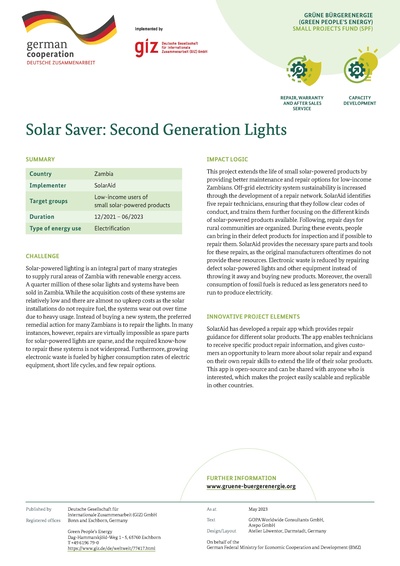
This project extends the life of small solar-powered products by providing better maintenance and repair options for low-income Zambians. Off-grid electricity system sustainability is increased through the development of a repair network. SolarAid identifies five repair technicians, ensuring that they follow clear codes of conduct, and trains them further focusing on the different kinds of solar-powered products available. Following, repair days for rural communities are organized. During these events, people can bring in their defect products for inspection and if possible to repair them. SolarAid provides the necessary spare parts and tools for these repairs, as the original manufacturers oftentimes do not provide these resources. Electronic waste is reduced by repairing defect solar-powered lights and other equipment instead of throwing it away and buying new products. Moreover, the overall consumption of fossil fuels is reduced as less generators need to run to produce electricity.
GBE Component
Small Projects Fund
Categories
- Skills Development
- Energy Access
Factsheet
Location
Country SPF
Zambia
Geographic coordinates of project site
{{#geocode: -13.9695, 28.6788}}
Latitude Longitude