Difference between revisions of "Solar Water Heaters for the Healthcare Sector"
From energypedia
***** (***** | *****) |
***** (***** | *****) |
||
| Line 3: | Line 3: | ||
|GBE organisation=Laboratoire d’Energétique et de Mécanique Appliquées de l’Ecole Polytechnique d’Abomey-Calavi / Université d’Abomey-Calavi (LEMA/ EPAC/UAC) | |GBE organisation=Laboratoire d’Energétique et de Mécanique Appliquées de l’Ecole Polytechnique d’Abomey-Calavi / Université d’Abomey-Calavi (LEMA/ EPAC/UAC) | ||
|GBE date start=July 2022 | |GBE date start=July 2022 | ||
| − | |GBE date end= | + | |GBE date end=September 2023 |
|GBE project description=The maternity wards of two health centers need to be equipped with solar water heaters to improve hygiene on site and at the same time save costs and protect resources (forest). To this end, two locally easy-to-replicate, low-cost boiler models are developed by the project. Subsequently, four craftsmen are trained in design and manufacture of the solar water boilers. The project measures are divided into three phases: (1) Provision of hot water to two selected non-profit, non-governmental hospitals; (2) Capacity building: Train craftsmen in the construction of the solar boilers; (3) Enable the hospital staff to use and maintain the systems autonomously. The beneficiaries of the project make a small financial contribution in return, from which the maintenance of the systems is financed. The project activities lead to the effect that the skills to construct hot water boilers are taken over by the trained craftsmen. Similarly, the training enables the hospital staff to operate and maintain the heaters in such a way that their working life will be extended accordingly. | |GBE project description=The maternity wards of two health centers need to be equipped with solar water heaters to improve hygiene on site and at the same time save costs and protect resources (forest). To this end, two locally easy-to-replicate, low-cost boiler models are developed by the project. Subsequently, four craftsmen are trained in design and manufacture of the solar water boilers. The project measures are divided into three phases: (1) Provision of hot water to two selected non-profit, non-governmental hospitals; (2) Capacity building: Train craftsmen in the construction of the solar boilers; (3) Enable the hospital staff to use and maintain the systems autonomously. The beneficiaries of the project make a small financial contribution in return, from which the maintenance of the systems is financed. The project activities lead to the effect that the skills to construct hot water boilers are taken over by the trained craftsmen. Similarly, the training enables the hospital staff to operate and maintain the heaters in such a way that their working life will be extended accordingly. | ||
Revision as of 14:23, 18 September 2023
Solar Water Heaters for the Healthcare Sector
Last edit made by Helen Mengs on 2024-05-07. This is a wiki, do not hesitate to update information by clicking on "Edit with form".
Key Data
Organisation
Laboratoire d’Energétique et de Mécanique Appliquées de l’Ecole Polytechnique d’Abomey-Calavi / Université d’Abomey-Calavi (LEMA/ EPAC/UAC)
Duration
July 2022 - September 2023
Project Description
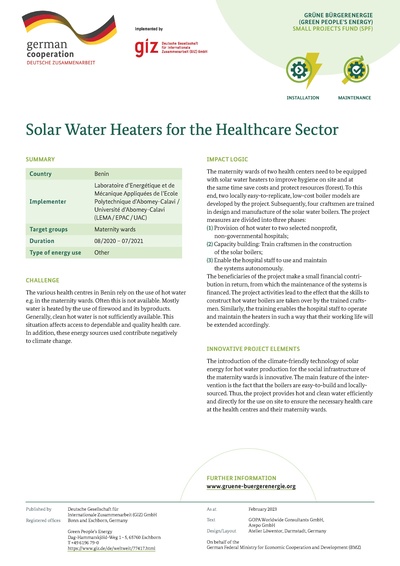
The maternity wards of two health centers need to be equipped with solar water heaters to improve hygiene on site and at the same time save costs and protect resources (forest). To this end, two locally easy-to-replicate, low-cost boiler models are developed by the project. Subsequently, four craftsmen are trained in design and manufacture of the solar water boilers. The project measures are divided into three phases: (1) Provision of hot water to two selected non-profit, non-governmental hospitals; (2) Capacity building: Train craftsmen in the construction of the solar boilers; (3) Enable the hospital staff to use and maintain the systems autonomously. The beneficiaries of the project make a small financial contribution in return, from which the maintenance of the systems is financed. The project activities lead to the effect that the skills to construct hot water boilers are taken over by the trained craftsmen. Similarly, the training enables the hospital staff to operate and maintain the heaters in such a way that their working life will be extended accordingly.
GBE Component
Small Projects Fund
Categories
- Productive Use
Factsheet
Location
Country SPF
Benin
Geographic coordinates of project site
{{#geocode: 6.51096, 2.33031}}
Latitude Longitude