|
|
| Line 1: |
Line 1: |
| | + | |
| | + | = Overview = |
| | | | |
| | [[File:EN Productive Biogas Current and Future Development 2014.pdf|thumb|180px|Add caption here]] | | [[File:EN Productive Biogas Current and Future Development 2014.pdf|thumb|180px|Add caption here]] |
| | | | |
| − | <span style="color: rgb(34, 34, 34); font-family: Verdana, Geneva, Tahoma, sans-serif; font-size: 12px; line-height: 24px;">The question that gave rise to this work was as to why no substantial productive biogas sector had emerged in any developing country before. Which are the market barriers inhibiting sector growth? Why have productive biogas systems not reached a larger scale? Can productive biogas, particularly those systems that are community owned, be deployed in a sustainable way? The five case studies outlined in this publication, seeking to fill these knowledge gaps, provide a detailed description of productive biogas projects led by FACT and SNV in Mali, Uganda, Vietnam, Honduras and Peru. They openly list the challenges and lessons learned to be considered before replication.</span>
| + | The question that gave rise to this work was as to why no substantial productive biogas sector had emerged in any developing country before. Which are the market barriers inhibiting sector growth? Why have productive biogas systems not reached a larger scale? Can productive biogas, particularly those systems that are community owned, be deployed in a sustainable way? The five case studies outlined in this publication, seeking to fill these knowledge gaps, provide a detailed description of productive biogas projects led by FACT and SNV in Mali, Uganda, Vietnam, Honduras and Peru. They openly list the challenges and lessons learned to be considered before replication.<ref>SNV (2014). Productive Biogas: Current and Future Development. Retrieved from http://www.snvworld.org/en/regions/africa/publications/productive-biogas-current-and-future-development </ref> |
| − | <div class="field field-name-field-jaar field-type-taxonomy-term-reference field-label-inline clearfix" style="margin: 0px 0px 0.4em; overflow: hidden; color: rgb(34, 34, 34); font-family: Verdana, Geneva, Tahoma, sans-serif; font-size: 12px; line-height: 24px;"><div class="field-label" style="font-weight: bold; float: left; width: 12em;">Year:</div><div class="field-items" style="float: left;"><div class="field-item even">2014</div></div></div><div class="field field-label-inline clearfix" style="margin: 0px 0px 0.4em; overflow: hidden; color: rgb(34, 34, 34); font-family: Verdana, Geneva, Tahoma, sans-serif; font-size: 12px; line-height: 24px;"><div class="field-label" style="font-weight: bold; float: left; width: 12em;">Country:</div><div class="field-items" style="float: left;">Honduras, Mali, Peru, Uganda, Vietnam</div></div><div class="field field-label-inline clearfix" style="margin: 0px 0px 0.4em; overflow: hidden; color: rgb(34, 34, 34); font-family: Verdana, Geneva, Tahoma, sans-serif; font-size: 12px; line-height: 24px;"><div class="field-label" style="font-weight: bold; float: left; width: 12em;">Region:</div><div class="field-items" style="float: left;">Africa, Asia, Latin America, World</div></div><div class="field field-label-inline clearfix" style="margin: 0px 0px 0.4em; overflow: hidden; color: rgb(34, 34, 34); font-family: Verdana, Geneva, Tahoma, sans-serif; font-size: 12px; line-height: 24px;"><div class="field-label" style="font-weight: bold; float: left; width: 12em;">Sector:</div><div class="field-items" style="float: left;">Renewable energy</div></div><div class="field field-name-field-auteur field-type-taxonomy-term-reference field-label-inline clearfix" style="margin: 0px 0px 0.4em; overflow: hidden; color: rgb(34, 34, 34); font-family: Verdana, Geneva, Tahoma, sans-serif; font-size: 12px; line-height: 24px;"><div class="field-label" style="font-weight: bold; float: left; width: 12em;">Author:</div><div class="field-items" style="float: left;"><div class="field-item even">SNV and FACT Foundation</div></div></div><div class="field field-name-field-paginas field-type-number-integer field-label-inline clearfix" style="margin: 0px 0px 0.4em; overflow: hidden; color: rgb(34, 34, 34); font-family: Verdana, Geneva, Tahoma, sans-serif; font-size: 12px; line-height: 24px;"><div class="field-label" style="font-weight: bold; float: left; width: 12em;">Pages:</div><div class="field-items" style="float: left;"><div class="field-item even">109</div></div></div><div class="field field-name-field-taalvandocument field-type-taxonomy-term-reference field-label-inline clearfix" style="margin: 0px 0px 0.4em; overflow: hidden; color: rgb(34, 34, 34); font-family: Verdana, Geneva, Tahoma, sans-serif; font-size: 12px; line-height: 24px;"><div class="field-label" style="font-weight: bold; float: left; width: 12em;">Document language:</div><div class="field-items" style="float: left;"><div class="field-item even">English</div></div></div><div class="field field-name-field-typedocument field-type-taxonomy-term-reference field-label-inline clearfix" style="margin: 0px 0px 0.4em; overflow: hidden; color: rgb(34, 34, 34); font-family: Verdana, Geneva, Tahoma, sans-serif; font-size: 12px; line-height: 24px;"><div class="field-label" style="font-weight: bold; float: left; width: 12em;">Type:</div><div class="field-items" style="float: left;"><div class="field-item even">Publication</div></div></div>
| + | |
| | + | = Information About the Publication = |
| | + | |
| | + | '''Year''': 2014 <br/> |
| | + | |
| | + | '''Country''': Honduras, Mali, Peru, Uganda, Vietnam <br/> |
| | + | |
| | + | '''Region''': Africa, Asia, Latin America, World <br/> |
| | + | |
| | + | '''Sector''': Renewable Energy <br/> |
| | + | |
| | + | '''Author''': SNV and FACT Foundation <br/> |
| | + | |
| | + | '''Pages''': 109 <br/> |
| | + | |
| | + | '''Document Language''': English <br/> |
| | + | |
| | + | '''Type''': Publication |
| | + | |
| | <br/> | | <br/> |
| | + | |
| | + | = Further Information = |
| | + | |
| | + | *[[Portal:Biogas|Biogas portal on energypedia]] |
| | + | *[http://www.snvworld.org/en/sectors/renewable-energy/publications SNV Publications] |
| | + | |
| | + | = Reference = |
| | + | |
| | + | *<references /><br/> |
Overview
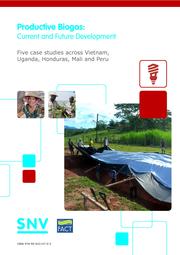
The question that gave rise to this work was as to why no substantial productive biogas sector had emerged in any developing country before. Which are the market barriers inhibiting sector growth? Why have productive biogas systems not reached a larger scale? Can productive biogas, particularly those systems that are community owned, be deployed in a sustainable way? The five case studies outlined in this publication, seeking to fill these knowledge gaps, provide a detailed description of productive biogas projects led by FACT and SNV in Mali, Uganda, Vietnam, Honduras and Peru. They openly list the challenges and lessons learned to be considered before replication.[1]
Information About the Publication
Year: 2014
Country: Honduras, Mali, Peru, Uganda, Vietnam
Region: Africa, Asia, Latin America, World
Sector: Renewable Energy
Author: SNV and FACT Foundation
Pages: 109
Document Language: English
Type: Publication
Further Information
Reference
↑ SNV (2014). Productive Biogas: Current and Future Development. Retrieved from http://www.snvworld.org/en/regions/africa/publications/productive-biogas-current-and-future-development