Difference between revisions of "Fuel Prices Colombia"
***** (***** | *****) |
***** (***** | *****) |
||
| Line 1: | Line 1: | ||
{{Fuel Price Factsheet | {{Fuel Price Factsheet | ||
|Fuel Price Country=Colombia | |Fuel Price Country=Colombia | ||
| − | |Fuel Pricing Policies= | + | |Fuel Pricing Policies="Fuel prices are controlled and price ceilings are set by the Ministry of Mines and Energy, subject to the ultimate authority of Superintendency of Industry and Commerce (Superintendencia de Industria y Comercio, SIC), which exercises control over price increases. Price setting is at the discretion of government. A fuel stabilization fund for gasoline and diesel was created at the end of 2008, the purpose of which was to eliminate fuel price subsidies. Budgetary transfers for fuel subsidies in 2009 amounted to 4,906 billion pesos (US$2.3 billion). There are no rules governing withdrawals from the fund, as in Chile. By end-2011, the fund’s deficit had grown to 2.2 trillion pesos (US$1.2 billion). Government posts historical statistics on retail prices of gasoline, diesel, and CNG on its Web site. Hedging cost Ecopetrol, the national oil company, US$450 million in 2011, and incurred costs in six out of the past seven years, prompting a congressional hearing in 2012. The Ministry of Mines and Energy posts detailed price information by location for gasoline and diesel every month, dating back to July 2003." |
| − | |||
| − | |||
| − | + | (Source: Kojima, Masami. (2013, forthcoming). “Petroleum product pricing and complementary policies:Experience of 65 developing countries since 2009.” Washington DC: World Bank.) | |
| − | |||
| − | |||
| − | |||
| − | |||
| − | |||
| − | |||
| − | |||
|Fuel Currency=COP | |Fuel Currency=COP | ||
|Fuel Price Exchange Rate=1850.04 | |Fuel Price Exchange Rate=1850.04 | ||
Revision as of 08:51, 25 February 2013
Part of: GIZ International Fuel Price database
Also see: Colombia Energy Situation
Fuel Pricing Policies
| Local Currency: | COP |
| Exchange Rate: | 1850.04
|
| Last Update: |
"Fuel prices are controlled and price ceilings are set by the Ministry of Mines and Energy, subject to the ultimate authority of Superintendency of Industry and Commerce (Superintendencia de Industria y Comercio, SIC), which exercises control over price increases. Price setting is at the discretion of government. A fuel stabilization fund for gasoline and diesel was created at the end of 2008, the purpose of which was to eliminate fuel price subsidies. Budgetary transfers for fuel subsidies in 2009 amounted to 4,906 billion pesos (US$2.3 billion). There are no rules governing withdrawals from the fund, as in Chile. By end-2011, the fund’s deficit had grown to 2.2 trillion pesos (US$1.2 billion). Government posts historical statistics on retail prices of gasoline, diesel, and CNG on its Web site. Hedging cost Ecopetrol, the national oil company, US$450 million in 2011, and incurred costs in six out of the past seven years, prompting a congressional hearing in 2012. The Ministry of Mines and Energy posts detailed price information by location for gasoline and diesel every month, dating back to July 2003."
(Source: Kojima, Masami. (2013, forthcoming). “Petroleum product pricing and complementary policies:Experience of 65 developing countries since 2009.” Washington DC: World Bank.)
Fuel Prices and Trends
| Gasoline 95 Octane | Diesel | |
|---|---|---|
| in USD* |
|
|
| in Local Currency |
|
|
* benchmark lines: green=US price; grey=price in Spain; red=price of Crude Oil
Fuel Price Composition
Price composition for one litre of Gasoline 95 Octane as of 2012/04/01.
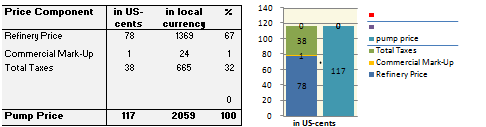
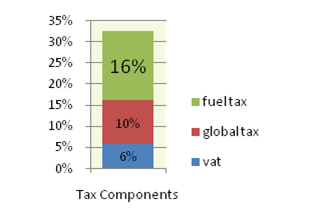
Source: http://www.ecopetrol.com.co/contenido.aspx?catID=192&conID=36336&pagID=129391
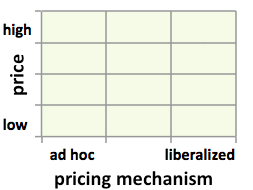
At a Glance
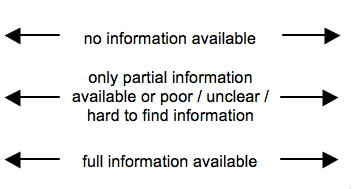
| Regulation-Price-Matrix |
| ||||
  |

|
|
| ||
Sources to the Public
| Type of Information | Web-Link / Source |
|---|---|
| Other Information | http://www.bamep.gov.co (Bank of the Republic of Colombia) |
| Other Information | http://www.creg.gov.co (Energy and Gas Regulatory Commission) |
| Other Information | http://www.ecopetrol.com (Colombian Petroleum Company) |
| Other Information | http://www.minminas.gov.co (Ministry of Mines and Energy) |
| Other Information | http://www.dinero.com/opinion/columnistas/articulo/la-encrucijada-del-precio-combustibles/186095 |
| Pricing Mechanism | http://bit.ly/1q2OFJ4 |
| Pump prices and margins | http://www.ecopetrol.com.co/contenido.aspx?catID=192&conID=36336&pagID=129391 |
| Pump prices and margins | http://bit.ly/1q2OFJ4 |
| Wholesale Prices | http://www.ecopetrol.com.co/contenido.aspx?catID=192&conID=36336&pagID=129391 |
Contact
Please find more information on GIZ International Fuel Price Database and http://www.giz.de/fuelprices
The following coordinate was not recognized: {{#geocode: Colombia|google }}.