Knowledge fuels change - Support energypedia!
For over 10 years, energypedia has been connecting energy experts around the world — helping them share knowledge, learn from each other, and accelerate the global energy transition.
Today, we ask for your support to keep this platform free and accessible to all.
Even a small contribution makes a big difference! If just 10–20% of our 60,000+ monthly visitors donated the equivalent of a cup of coffee — €5 — Energypedia would be fully funded for a whole year.
Is the knowledge you’ve gained through Energypedia this year worth €5 or more?
Your donation keeps the platform running, helps us create new knowledge products, and contributes directly to achieving SDG 7.
Thank you for your support, your donation, big or small, truly matters!
File:Innovative risk finance solutions – Insights for geothermal power development in Kenya and Ethiopia.pdf
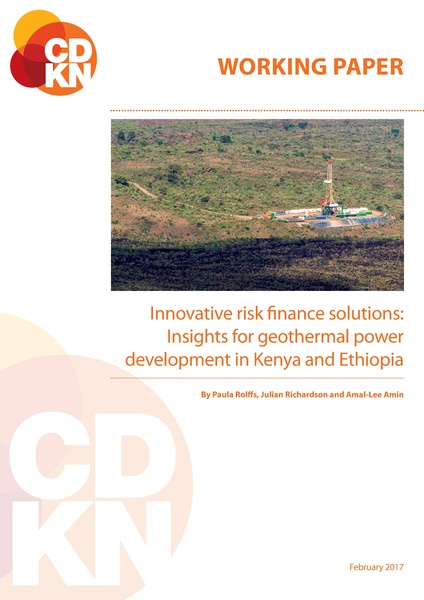 Size of this JPG preview of this PDF file: 424 × 600 pixels. Other resolution: 170 × 240 pixels. |
Original file (2,480 × 3,507 pixels, file size: 0 bytes, MIME type: application/pdf, 12 pages)
Summary
| Description |
English: Geothermal development is on the rise in many regions of the world. However, the high costs of field development, coupled with the high risks associated with resource exploration and drilling, still pose a significant barrier to private sector financing.
Insurance can mitigate the risks to investors and increase flows of private finance to the industry. A project by Parhelion, a private sector insurance and risk company focused on climate finance, funded by CDKN, aimed to improve the technical capacity of Kenya’s and Ethiopia’s local insurance industries for using geothermal risk mitigation instruments. A consultative process with relevant stakeholders in these countries yielded insights and recommendations for international, multilateral and bilateral institutions that are looking to support geothermal resource development. The analysis was enriched by E3G’s expertise in analysing climate finance flows. The study found that international, multilateral and bilateral institutions should: Support technical assistance and capacity building, which takes into account the needs of all relevant stakeholders involved within specific country and market contexts. Provide targeted concessional finance by taking into account all possible risk mitigation instruments during project development, and by envisioning the leverage of private finance as early as possible. Use insurance instruments to target specific, well defined risks: this can offer very high leverage ratios on the use of public funds, and crowd in private sector insurance capital. |
|---|---|
| Source |
Climate and Development Knowledge Network (CDKN) |
| Date |
2017-03-14 |
| Author |
Paula Rolffs, Julian Richardson and Amal-Lee Amin |
| Permission |
See license tag below. |
| This file is licensed under the Creative Commons Attribution-NonCommercial-NoDerivs 3.0 license. | ||
|
File history
Click on a date/time to view the file as it appeared at that time.
| Date/Time | Thumbnail | Dimensions | User | Comment | |
|---|---|---|---|---|---|
| current | 16:56, 14 March 2017 |  | 2,480 × 3,507, 12 pages (0 bytes) | ***** (***** | *****) | User created page with UploadWizard |
You cannot overwrite this file.
File usage
There are no pages that use this file.