Fuel Prices Bolivia
Part of: GIZ International Fuel Price database
Fuel Pricing Policies
| Local Currency: | BOB |
| Exchange Rate: | 6.88
|
| Last Update: |
- Bolivia is net-importer of fossil fuels from Venezuela and Argentina
- Fuels are sold subsidized
- Prices are heavily regulated
- Price gaps to neighbouring countries enforces smuggling
- Low revenue for oil producers (27 USD per barrel) leads to underinvestment
"Fuel prices are uniform, controlled by government, and frozen for years at a time. Since Jan 2009, vehicles with foreign licence plates have been charged international prices, set every quarter. On the domestic market, the price of oil is US$27/bbl; concerned about declining oil production, government issued Supreme Decree 1202 in Mar 2012, providing a tax credit of US$30/bbl to foreign companies in addition to US$10 in cash they were receiving. As late as Dec 24, 2010, government was reportedly denying any intention to reform subsidies. However, just two days later, government as part of a broader subsidy reform increased diesel price by 83% and gasoline by 73%, the largest since 1991 when prices went up 35%. The increases were completely reversed 5 days later due to widespread protests, as was food subsidy reduction. In Feb 2011, government created a new ministry of communications, 8 years after such a ministry had been abolished. Fuel subsidies have amounted to about 3% of GDP in recent years."
(Source: Kojima, Masami. (2013, forthcoming). “Petroleum product pricing and complementary policies:Experience of 65 developing countries since 2009.” Washington DC: World Bank.)
Fuel Prices and Trends
| Gasoline 95 Octane | Diesel | |
|---|---|---|
| in USD* |
|
|
| in Local Currency |
|
|
* benchmark lines: green=US price; grey=price in Spain; red=price of Crude Oil
Fuel Price Composition
Price composition as of 2002/12/01.
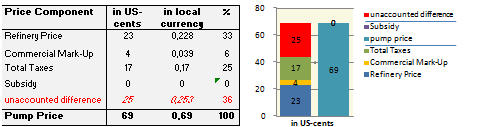
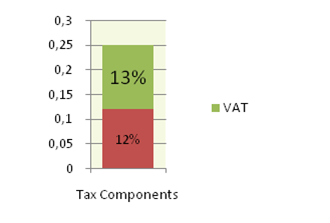
Source: example to estimate %-values for each component
http://uneprisoe.org/Pricing/FuelPricingPolicies.pdf pages 15-18
http://www.tmf-vat.com/international-vat-rates-2010/94-bolivia-vat-rate.html
At a Glance
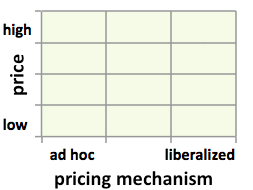
| Regulation-Price-Matrix |
| ||||
  |

|
|
| ||
Sources to the Public
| Type of Information | Web-Link / Source |
|---|---|
| Other Information | http://www.bolivia-industry.com (National Chamber of Industry) |
| Other Information | http://www.bcb.gov.bo/ (Central Bank of Bolivia) |
| Other Information | http://www.cbli.org.bo (Bolivian Chamber of Hydrocarbons) |
| Pump prices and margins | http://www.hidrocarburos.gob.bo/MHE2012/ |
Contact
Please find more information on GIZ International Fuel Price Database and http://www.giz.de/fuelprices
The following coordinate was not recognized: {{#geocode: Bolivia|google }}.