EduEnergy Conference: Building Bridges for Sustainable Energy Learning
Summary
The Edu-Energy Conference: Building Bridges for Sustainable Energy Learning brought together experts and stakeholders from across the Western Balkans to discuss the current challenges in the renewable energy sector and explore ways forward. The event, held online on 15 March 2024, focused particularly on the skills needed to support the growth of renewable energy.
Key speakers provided insights into the current state of the energy sector and its future developments, as well as exploring the social response to these challenges.
Organised by the Education Reform Initiative of South Eastern Europe (ERI SEE) in cooperation with the Deutsche Gesellschaft für Internationale Zusammenarbeit (GIZ) and the Chamber of Commerce and Industry of Serbia, the conference took place within the framework of the Renewable Energy Services in Education and Training (RESET) project.
The RESET project is implemented by ERI SEE as part of a larger GIZ-led regional initiative, Green Agenda: Decarbonising the Electricity Sector in the Western Balkans, commissioned by the German Federal Ministry for Economic Cooperation and Development (BMZ).
Around 200 participants from across the region attended the event. Opening remarks were delivered by Ljubinko Savić, Secretary of the Association for Energy and Mining of the Chamber of Commerce and Industry of Serbia; Ivana Marković Bošković, Senior Expert on Green Agenda from the Regional Cooperation Council (RCC); Nicolas Heger, Project Manager, and Ergi Bregasi, Advisor from GIZ; and Tina Šarić, Director of ERI SEE.
After an input of three insightful presentations, an expert panel discussed various aspects of new labour market demands, caused by the green transition (see below for a short summary).
In her closing address, Tina Šarić (ERI SEE) on behalf of the organizers summed up the discussions and underlined that while coal and wood still dominate as energy sources and efficiency remains low, the Western Balkans are moving steadily toward a green transition. She emphasized that this process requires strategic cooperation across sectors and stronger alignment between education systems, labor market needs, and environmental goals, especially with a focus on curricula development.
Šarić also highlighted the growing importance of cross-border education programs under the Green Agenda for the Western Balkans, which can help develop regional skills and expertise in renewable energy and energy efficiency. She concluded that the green transition is not only a technical but also a social transformation - to which every individual can contribute by reducing consumption and environmental impact.
Presentations

Energy production and consumption in the Western Balkans: Over the hills and far away (Aleksandar Macura)
Mr Aleksandar Macura, Co-founder and Program Director, RES Foundation invited the audience to understand that the way in which we produce, transform and consume energy is based on the decisions made many decades ago, and does not facilitate value creation that our societies need today.
The presentation can be accessed here.

Path to a sustainable energy future of the Western Balkans (Vedad Suljić)
Mr Vedad Suljić, Managing Director, Center for Economic, Technological and Environmental Development Sarajevo – CETEOR stated that there is an urgent need to increase capacities of key actors working in sectors related to decarbonization (business representatives, civil servants, educators etc.) to be able to utilize decarbonization related available funds, e.g. own funds, EU funds, private finance. These capacities include education, skills&tools and procedure related to activities relevant to decarbonization effort. To this regard, VET plays a crucial tool and through a systemized and streamlined WB-wide approach the WB economies could build competitive advantage and prevent brain drain in the future.
The presentation can be accessed here.
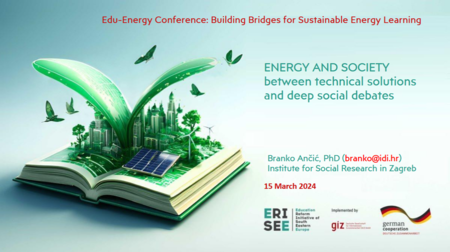
ENERGY AND SOCIETY between technical solutions and deep social debates (Branko Ančić)
Doc. dr. sc. Branko Ančić, Senior Research Associate, Institute for Social Research in Zagreb - IDIZ emphasized that current situation of overall potential collapse of contemporary civilization is driven with the development of extractivist economy completely dependant on fossil fuel energy. In order to achieve energy transition, contemporary societies, including Western Balkan societies, need to completely change how we produce energy and need to change socio/economic imperative of pursuit of economic growth which consequentially leads to overextraction of natural resources which are limited.
The presentation can be accessed here.
Expert Panel Discussion
The EduEnergy conference also hosted an expert panel, moderated by Mr Vedad Suljić, with panelists being:
- Dr Ejvis Gishti,General Director, National Agency for VET and Qualifications, Albania
- Valbona Kadrijaj, Quality, OSH & Training Director Kosovo Electricity Distribution and Supply Company – KEDS Academy, Kosovo*
- Mirjana Kovačević, Head of the Center for Education and Dual Education and the Director of Business Academy, Chamber of Commerce and Industry of Serbia
- Sandra Brkanović, Head of the Department for Research and Development of Qualifications, Center for Vocational Education, Montenegro
- Dr Susan Gill, Manager of the Climate Strategy and Skills, SOLAS, Ireland
- Hamid Mehinović, Senior Energy Expert, Center for Economic, Technological and Environmental Development Sarajevo – CETEOR, Bosnia and Herzegovina
The panelists exchanged their specific activities of aligning with the new demands of the labour market, caused by the green transition, each in their scope of work and competences: preparation of occupational standards and qualifications in cooperation with the business sector that clearly expresses its needs for new skills for renewable energy; research on which jobs and activities will be needed as a result of the Green transition; developing trainings for adult population through short training programmes; organizing free education for businesses on how to adjust to the requirements of the Green Agenda; enabling dual learning activities for students in companies that deal with green jobs; and development of policies in cooperation with stakeholders, taking into consideration specific national and above-national contexts and requirements.
--FORCETOC--