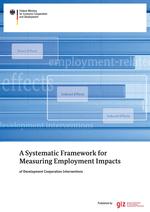
A Systematic Framework for Measuring Employment Impacts of Development Cooperation Interventions
About the Publication
|
Title: A Systematic Framework for Measuring Employment Impacts of Development Cooperation Interventions Authors: Jochen Kluve and Jonathan Stöterau Published by: Deutsche Gesellschaft für Internationale Zusammenarbeit (GIZ) GmbH Published Date/Place : December 2014, Eschborn Sector: Renewable Energy and Energy Efficiency Download link: A Systematic Framework for Measuring Employment Impacts of Development Cooperation Interventions |
 |
Summary
This paper summarizes the key features of a systematic framework for assessing the aggregate employment impacts of a portfolio of development cooperation interventions. The methodological approach follows a bottom-up procedure based on three steps: (i) estimating employment effects at the intervention level, net of the counterfactual scenario; (ii) estimating (economy-wide) employment impacts of interventions taking into account employment-related indirect effects of the intervention such as displacement, substitution and multipliers; (iii) aggregating these employment impacts across the portfolio and deriving comparable parameter values for employment effects.
Further Information
Check out the following publications related to job creation in the renewable sector:
- Green Jobs - Impacts of a Green Economy on Employment
- Measuring Employment Effects of Technical Cooperation Interventions - Some Methodological Guidelines
- Jobs Potentially Destroyed Due to Access to Modern Energy Services
Reference
|
This article is part of the RE-ACTIVATE project. RE-ACTIVATE “Promoting Employment through Renewable Energy and Energy Efficiency in the MENA Region” is implemented by the Deutsche Gesellschaft für Internationale Zusammenarbeit (GIZ) GmbH on behalf of the German Ministry for Economic Cooperation and Development (BMZ). |