Energy Practitioner Networks
Energy Practitioner Networks
WISIONS fostered regional partnerships and practitioner networks to facilitate knowledge development and sharing between practitioners and stakeholders and to induce the broader dissemination of decentralised renewable energy solutions. Four international networks have been consolidated and they each focus on a specific technical solution for a region. These networks actively involve more than 120 organisations and individuals who have long been committed to people-centred sustainable energy solutions.
Energy Practitioners – The People Behind Every Successful Energy Project
The key actors on the frontline of the ongoing efforts to provide energy services to unelectrified and under-served areas in developing and emerging countries are considered to be “practitioners”. These practitioners work for non-governmental organisations, as energy entrepreneurs, in energy agencies, for small and medium-sized enterprises or as independent experts. Together with associated organisations, they are based and operate in the target areas and offer a direct link to communities and end-users of the energy services.
Consequently, they are often more than simply providers of technology; ideally they should be good organisers, financial managers, problem solvers, trainers and mediators as well as good technical installers.
Their work in the field and within communities provides the practitioners with in-depth knowledge, daily lessons and hands-on training – and is riddled with challenges. At the same time, these practitioners have only limited opportunities to share their experiences with other practitioners or stakeholders such as policymakers or decision-makers.
We consider Energy Practitioner Networks to be an important means for facilitating effective knowledge exchange and mutual learning, giving practitioners a voice. As such, these networks play an important role in the transformation towards (decentralised) sustainable energy systems in off-grid regions.
Networks – Key Elements
Social networks – relationships between a set of actors such as individuals or organisations – are widespread and recognised for facilitating successful international cooperation and exchanging research knowledge.[1]
Energy practitioner networks in the global south, which in this publication are defined as social networks that involve and interlink practitioners active in the field of decentralised energy solutions, are still scarce.
Network is a generic term and in different social networks the type of members, topics, organisational structure and means of communication differ enormously; however basic preconditions apply to every social (knowledge) network. These include the purpose of the network, its structure and its processes.[2][3]
Purpose
- Shared target and vision – a basic understanding among the members that only by working jointly can the mutual targets be achieved and the mutual problems solved.
- Group composition/landscape of members – the network’s members must be sufficiently heterogenic to allow for mutual learning, but not too different to hinder exchange.
Structure
- Member’s mutuality – all members recognise that every member is an expert who can contribute, but who can also gain from the cooperation within a sound ratio of give and take. This spirit is facilitated through mutual trust and a flat network hierarchy.
- Network structure and formalising relationships – a basic structure is crucial and should include a clear organisational plan, clear decision-making processes and clearly allocated responsibilities. Ideally the network structure should be planned when the network is initially created.
- Promoter – it is helpful to have an internal (or external) promoter or to develop a culture of cooperation and support the development of competencies, external relationships and advocacy.
Processes
- Communication – the relationships between the actors need to be maintained by means of (targeted) communication.
- Active exchange & common activities – a core element is the actual interaction between the members, which must take place regularly in order for the network to be effective and become sustainable.
- Monitoring impact – last but not least, measuring the impact and value of the network, as well as the functionality and efficiency of its work, are elements that need to be considered.
Specifically, knowledge networks provide an opportunity to foster the dissemination of decentralised sustainable energy solutions beyond the timeframe and scope of individual projects by emphasising joint value creation, by strengthening the capacity of all members and by providing more options to transform knowledge into policy and practice as well as to influence decision-making processes.[4][5][6][7]
WISIONS Supported Practitioner Networks
Regional practitioner networks were an important element of the WISIONS initiative. A central finding from project support provided by WISIONS is that local capacity-building is crucial for ensuring the success and sustainability of clean energy projects.
Therefore, the WISIONS approach relied on fostering and maintaining cooperation with and between capable and committed individuals and organisations by promoting the foundation of energy practitioner networks and supporting existing networks.
The aim was to facilitate knowledge sharing between local practitioners and other relevant stakeholders in order to develop local expertise in specific focus technologies, contributing ultimately to the broader dissemination of decentralised renewable energy technologies.
The following four networks were supported:
- RedBioLAC: the Latin American biogas network
- RedBioCol : the Colombian network for energy from biomass
- HydroEmpowerment Network (HPNET): for micro-hydropower in South and South East Asia
- Wind Empowerment: the global network for small wind turbines
The four networks involve more than 120 organisations and individual members committed to people-centred sustainable energy solutions. The direct support provided by WISIONS offered basic co-funding for management and coordination, as well as facilitating face-to-face gatherings and other network events. WISIONS also provided financial support to a number of workshops, selected projects and other exchange activities via open calls for its supporting scheme SEPS – Sustainable Energy Project Support. To promote mutual learning between the networks, a format for regular exchanges between the network coordinators had been initiated.
The WISIONS team offered advice to the network coordinating bodies and steering groups on challenges faced and strategies for further development. However, all the networks were fully self-reliant in their decision-making processes and aimed to become sustainable in the long-term by consolidating their funding and support from advisory bodies.
Structure and Key Activities

Most important for day-to-day operations is the network management, a function carried out by the coordinator. The coordinator is responsible for internal and external communications, documentation and organisational tasks as well as – at least partly – for advocacy and fundraising. The coordinator is supported and supervised by a board or steering group, which meets regularly, develops the network strategy and makes key decisions. A handful of member experts are involved in thematic working groups to discuss problems, develop concepts or formulate studies, activities or further capacity-building.
Impacts
The four energy practitioner networks emerged and developed differently according to particular conditions (technological, geographical and socio-political), but share key objectives: strengthening the capacity of members through collaboration and knowledge exchange and advocacy by fostering dialogue and sharing knowledge with relevant stakeholders.
They all have members with a strong shared vision, are coordinated effectively and have a dynamic approach. For most of the practitioners, the network events and activities are unique experiences. The networks often provide the practitioners with the opportunity to widen their focus from dealing with pressing local community aspects to considering issues from a regional or even global perspective. It is inspiring for the practitioners to realise there are similar people and organisations in neighbouring countries who share the same challenges but also the same aims.
However, the wide-ranging geographical distribution and associated long distances between member organisations make maintaining active communication within the networks an on-going challenge. Therefore, annual/bi-annual gatherings are particularly important for strengthening and revitalising mutual trust through direct personal contact and face-to-face communication.
Notwithstanding their relatively short existence, the networks supported by WISIONS have already become acknowledged as important exchange platforms for practitioners and other stakeholders working at the forefront of delivering sustainable energy services to households and communities in the developing world.
Although time alone will demonstrate the medium and long-term impacts, initial effects are already evident. These include internal outcomes, such as increased knowledge due to hands-on training, and new transnational connections between both individual practitioners and organisations. In particular, intercultural understanding has increased and self-awareness of the role that local experts and NGOs play in achieving the global target of sustainable energy access has grown.
Externally, the networks have successfully contributed to increasing the positive perception of small-scale decentralised energy technologies as viable alternatives to conventional energy sources and grid-connectivity. Representatives from local governments and national ministries, as well as the national media, have attended network events – raising awareness and attracting further interest in sustainable small-scale energy solutions.
RedBioLAC
Founded in 2009 in Peru, RedBioLAC – Red de Biodigestores Para Latino América y el Caribe – is a multinational network connecting actors in the biogas field across Latin America and the Caribbean. It brings together organisations, private enterprises and individuals from 14 countries (Mexico, Guatemala, Honduras, Nicaragua, Costa Rica, Colombia, Ecuador, Bolivia, Paraguay, Chile, Cuba, Argentina, Peru and Spain).
Its aim is to achieve the universal use of biodigester technology as a tool for contributing to a better quality of life and empowering the region’s population.
In May 2009, a workshop took place in Cajamarca, Peru, under the framework of a former SEPS project, which focused on sharing experiences on the use of domestic biodigesters in Latin America. The lively discussions demonstrated huge potential for mutual learning. Although there is a long history of initiatives which have adapted, tested and further developed small and medium-sized biogas technologies (ranging from 4m3 to 300m3), forums for exchanging experiences were almost non-existent, especially for practitioners active in the field.
During a second meeting in 2010 in Costa Rica, the network was formalised and the first strategic plan for RedBioLAC was developed. The focus of the founding members was on low-cost and locally-produced biodigesters that could easily be maintained, such as tubular (plug flow) systems.
In its early years the exchange concentrated on technical challenges and the development of domestic biogas systems based on livestock waste, but over time RedBioLAC’s range of topics and member organisations diversified.
RedBioCol
RedBioCol is a network of individuals and organisations committed to contributing to the sustainable development of Colombian society by promoting the use of biomass and organic residues for energy generation.
The national network was inspired by the Latin American network RedBioLAC, but has a broader objective as it includes biomass energy in all its forms, instead of focusing solely on biodigesters. Since RedBioCol’s foundation in 2012 in Guapotá, its membership has grown to 55 (in 2026) and includes farmers’ associations, NGOs, small and medium-sized enterprises with social purpose, social movements, universities and educational institutes in both rural and urban locations.
The network links practitioners within a single country and, as a result, it can help to facilitate more regular face-to-face meetings to intensify the synergies that exist between its members, as well as focusing on specific national political, economic and social conditions. The aim is to promote the use of biomass in Colombia to generate energy in order to realise potential benefits, particularly in the agricultural sector but also in other sectors with significant flows of organic residues.
Find more information about RedBioCol here.
HPNET - Hydro Empowerment Network in South and Southeast Asia
The Hydro Empowerment Network (HPNET) is a group of practitioners in South and Southeast Asia and a knowledge exchange platform that aims to advance and advocate for sustainable pico, micro and mini-hydropower for rural empowerment. Pico and micro-hydro power systems have huge potential, especially in the humid and hilly regions of South and Southeast Asia. Although micro-hydro is well established in several countries in the region, it faces a variety of challenges and has yet to reach its full potential. Established in 2013, the network addresses these challenges; its members have a wide range of expertise in policy, financing, technology development, watershed strengthening and community organising processes.
The WISIONS initiative initially acted as co-founder and has supported the network until 2022, by providing financial support and strategic advocacy for the coordination, gatherings and exchange activities.
Find more information about HPNET here.
Wind Empowerment
Wind Empowerment is a global association for the development of locally-manufactured small wind turbines (SWTs) for sustainable rural electrification. It aims to strengthen the capacity of its members through collaboration and knowledge exchange to promote and support small wind technology as a viable solution for rural electrification.
Small-scale wind turbines, in contrast to large-scale wind turbines, can be considered a niche technology. SWTs can offer viable off-grid power solutions where strong wind resources (4–7m/s and higher) are available and evenly distributed throughout the year, or in regions where the combination of small wind technology and solar PV can provide a reliable power supply. Moreover, the option to manufacture SWTs locally can offer a number of additional benefits, such as capacity-building for operations and maintenance, a shorter supply chain for spare parts and the creation of local employment.
Tthe Wind Empowerment association was formed in 2011 in Dakar, Senegal. The aim was to bridge the geographical gap between its members by providing a global platform for knowledge sharing and collaboration. While the online platform helped to facilitate knowledge sharing, establishing continuous collaborative activities among the members proved more challenging. During a second conference in 2014 in Athens, Greece, there was renewed motivation for the strategic development of the association, which led to changes in the association’s structure.
In parallel to the global network, WISIONS (in close cooperation with Green Empowerment) laid the foundation for a regional Latin American network on small wind – WindWorks – by facilitating two network meetings in Lima/Peru in 2011 and 2013. This regional partnership WindWorks merged with Wind Empowerment in 2014 and was supported by WISIONS.
Find more information about Wind Empowerment here.
Further Reading
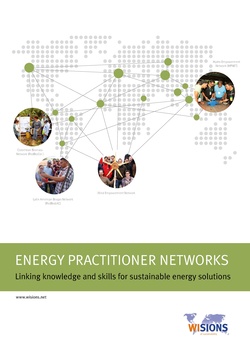
- Wuppertal Institut (2016). Energy practitioner networks. Linking knowledge and skills for sustainable energy solutions
- Wuppertal Institut (2016). Energy practitioner networks. Interconectando conocimiento y capacidades en soluciones energéticas sostenibles

References
- ↑ Henry, A. D.& Vollan, B. (2014). Networks and the Challenge of Sustainable Development. Annu. Rev. Environ. Resour. 2014, 39, 583–610.
- ↑ Neugebauer, U. & Beywl, W. Methoden zur Netzwerkevaluation (2006). Z. Für Eval. 2006, 249–286
- ↑ Gajo, M. et al (2013). Netzwerkevaluierung – Ein Leitfaden zur Bewertung von Kooperation in Netzwerken; GIZ: Eschborn, 2013.
- ↑ Creech, H. (2006). Measuring while you manage: Planning, monitoring and evaluating knowledge networks; International Institute for Sustainable Development: Winnipeg.
- ↑ Bellwald, S. et al (2013). Netzwerke und kooperationen in der Regionalentwicklung – Praxisblatt; regiosuisse – Netzwerkstelle Regionalentwicklung. Brig
- ↑ Borkenhagen, P. et al (2004). Netzwerkmanagement; Arbeitsgemeinschaft Betriebliche Weiterbildungsforschung e. V.: Berlin, 2004.
- ↑ GIZ (2015). Work the Net – A management guide for existing and emerging formal networks. Publications on international personnel development. Volume 5. Bonn, 2015.