Innovation Labs
WISIONS' Approach to Systemic Change

We have learned that a series of coherently interlinked actions through multi-stakeholder alliances is crucial for bringing about broader and deeper transformations. In order to provide such a level of coherence, WISIONS is building on the Wuppertal Institute’s Innovation Lab approach. The aim is to establish Innovation Labs that focus on rural and peri-urban energy solutions with the aim of improving local living conditions.
Innovation Labs:
- are multi-stakeholder alliances;
- focus on the development opportunities and challenges faced by rural populations in one country or region;
- mobilise resources for the co-design, practical validation, evaluation and scale-up of energy solutions that strengthen rural livelihoods;
- are composed of single but interrelated projects;
- integrate WISIONS’ knowhow from the concept stage of the individual projects.
Innovation Lab Nepal
Since 2023, the Innovation Lab has piloted decentralised renewable energy (DRE) models in Baglung and Jumla, including micro-hydro grid interconnection, electric cooking, e-mobility, and nature-based solutions for slope stabilization.
The overarching goal of the Innovation Lab Nepal is to strengthen the livelihoods of rural populations by applying decentralised renewable energy solutions in combination with sustainable landscape management practices.
To that aim, a multi-stakeholder process has been established involving local community organisations, local and national public actors, private suppliers of technology and services, and academics and researchers.
The intention is to leverage the different expertise and knowledge of these stakeholders to:
- Identify the development opportunities and challenges facing the rural communities involved
- Assess which renewable energy and landscape management solutions can effectively exploit these opportunities
- Design, implement and evaluate transformative actions that unlock the full potential of the most promising energy and landscape solutions
The lack of sustainable livelihood opportunities in rural areas of Nepal is a key factor driving the migration of young men and women to urban centres and countries overseas. We predict that the widespread use of decentralised renewable energy and sustainable landscape management in rural communities will generate employment opportunities (in SMEs both on and off farms), increase food security (from diversified agricultural activities) and enhance the resilience of the natural ecosystems of their landscapes (particularly of the Himalayan forests).
Overall, the IL Nepal aims to bring about systemic change to increase the options for people to build prosperous and fulfilling lives in rural Nepal, whilst also helping to address global sustainability challenges.
Reports
Understanding the Diffusion of E-cooking Solutions for Micro Enterprises in Rural Nepal
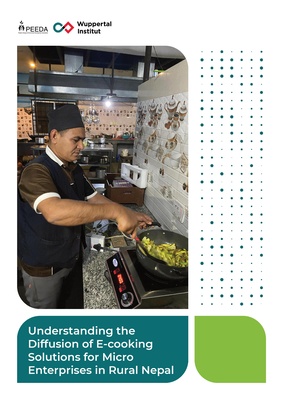
Understanding the Diffusion of E-cooking Solutions for Micro Enterprises in Rural Nepal
Although more than 95% of households now have access to electricity, the uptake of electric cooking (e-cooking) in commercial settings has so far been minimal. To date, most research and interventions have focused primarily on household-level adoption, leaving a significant evidence and experience gap for small businesses. At the same time, sustaining Nepal’s more than 1,800 micro-hydropower (MHP) plants in the mid-hills requires innovative approaches to increase electricity demand and secure their financial viability. Promoting the use of e-cooking solutions by local micro enterprises represents an opportunity to increase the productive use of the power generated by MHP plants. With its scalability and replicability across the mid-hill range, e-cooking provides a multidimensional intervention that links energy transition with sustainable mountain development.
Download in
Published in 2025
Pre-Feasibility Study on Electric Mobility in the Galkot-Badigad-Nisi Corridor
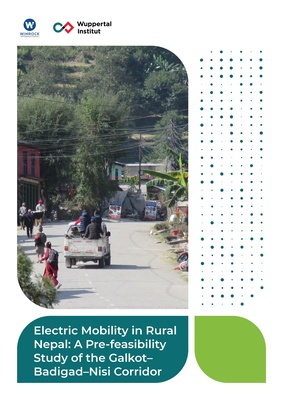
Pre-Feasibility Study on Electric Mobility in the Galkot-Badigad-Nisi Corridor
The Pre-feasibility Study for Electric Mobility in the Galkot-Badigad-Nisikhola Corridor explores the opportunities for deploying electric vehicles (EVs) as an alternative to the region’s urgent need for affordable and sustainable public transport. To evaluate this potential, the research combined field visits, key informant interviews (KIIs), structured surveys with driver and passengers to capture the local mobility pattern and service needs. It also employs financial modelling to assess the technical, socio-economic, and operational feasibility of deploying EVs along key routes in the corridor.
Download in
Published in 2025
Factsheets
Integrative approach to sustainable livelihoods of mountain communities: Strengthening the livelihoods of mountain communities in Nepal
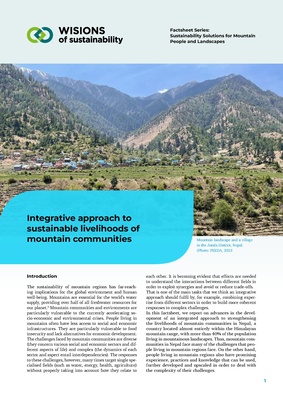
Integrative approach to sustainable livelihoods of mountain communities: Strengthening the livelihoods of mountain communities in Nepal
This factsheet highlights an integrative framework aimed at strengthening the livelihoods of mountain communities in rural Nepal. Focusing on the interplay between social, economic, and environmental conditions, the approach combines renewable energy solutions—such as micro-hydropower—with sustainable natural resource management. By empowering marginalized populations and local actors, the framework aims to build long-term community resilience, boost income generation, and preserve fragile mountain ecosystems against climate threats.
Download in:
Published in 2026
E-Cooking for Micro Enterprises in Nepal
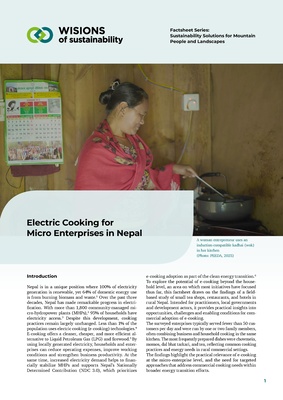
Electric Cooking for Micro Enterprises in Nepal
Despite 100% renewable electricity generation and 95% grid access in Nepal, 64% of energy relies on biomass, with less than 1% using electric cooking (e-cooking). Evaluated across 20 small commercial businesses in Baglung District, this pilot tested 2kW induction stoves and compatible cookware to assess commercial feasibility. Live peer demonstrations proved vital for overcoming adoption hesitation. Key barriers included electrical supply unreliability, high upfront costs (CapEx), scarce commercial-sized cookware, and a lack of local repair services. However, replacing expensive imported LPG with cheaper, efficient local electricity significantly dropped operational expenses (OpEx). High-usage businesses achieved investment payback in just 10–12 months. Beyond financial savings, e-cooking eliminates toxic indoor smoke, improves safety, enhances national energy resilience, absorbs wasted micro-hydro capacity, and supports Nepal's target of 15,000 e-cooking institutions by 2035.
Download in
Published in 2026
Productive use of energy in mountainous regions in Nepal

Productive use of energy in mountainous regions in Nepal
Centered on local economic development, this publication analyzes the productive use of energy (PUE) in mountainous areas of Nepal. It demonstrates how utilizing off-peak electricity from MHPs for processing agricultural yields, running small workshops, and operating commercial machinery drives rural enterprise growth. The factsheet highlights how integrating PUE initiatives optimizes plant utilization, improves MHP financial viability, creates jobs, and boosts overall community prosperity.
Download in
Published in 2025
Re-imagining the Future of Micro Hydro-plants in Nepal
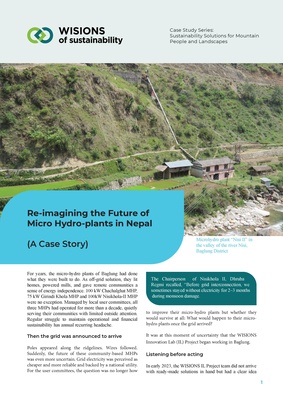
Re-imagining the Future of Micro Hydro-plants in Nepal
Off-grid community micro-hydropower plants (MHPs) in Baglung District—Chachalghat, Girindi Khola, and Nisikhola-II—faced severe operational decline and financial uncertainty following national grid expansion. Operating at under 35% capacity, their survival was threatened. Facilitated COMET workshops revealed that these plants produced substantial underutilized energy that could be monetized through grid interconnection rather than wasted. Transitioning required migrating informal user committees into formal cooperative business models to secure Viability Gap Funding via the Sustainable Energy Challenge Fund (SECF) and municipal support. Strengthening institutional capacity, financial auditing, and grid safety protocols proved more challenging than technical upgrades. On November 17, 2025, the MHPs successfully connected to the national grid, selling electricity to the Nepal Electricity Authority (NEA) and establishing a sustainable, revenue-generating enterprise model.
Download in
Published in 2026
MHP Grid Interconnection
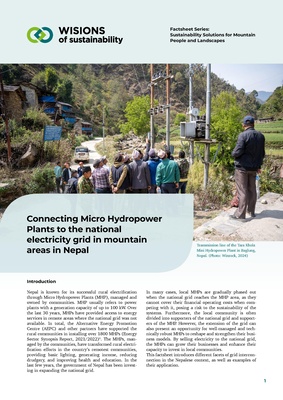
Connecting Micro Hydropower Plants to the national electricity grid in mountain areas in Nepal
This publication addresses the technical, regulatory, and economic dimensions of connecting off-grid micro-hydropower plants to Nepal’s national electricity grid. Interconnecting MHPs allows remote communities to sell surplus energy back to the grid, transforming local plants into profitable ventures while enhancing regional power stability. The factsheet outlines required policy updates, technical standardization, grid infrastructure improvements, and financial mechanisms needed to successfully implement grid-tied MHP models.
Download in
Published in 2025
Cooperative Business Models for MHPs
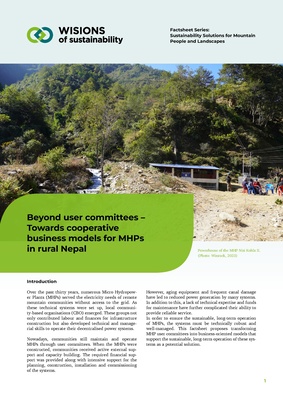
Beyond user committees – Towards cooperative business models for MHPs in rural Nepal
Moving beyond traditional community user committees, this factsheet advocates for transitioning MHPs into formal, cooperative business models. Operating as social cooperatives professionalizes management, enhances financial transparency, improves maintenance reliability, and enables communities to reinvest energy profits into local development projects. The document details institutional structures, capacity-building requirements, and policy changes necessary to foster sustainable, market-oriented energy management in rural areas.
Download in
Published in 2025
Bioengineering Practices
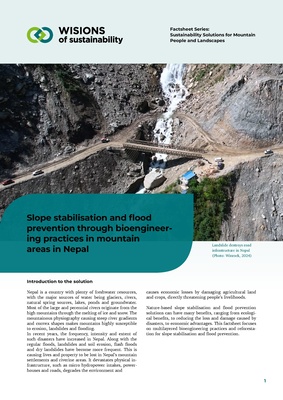
Slope stabilisation and flood prevention through bioengineering practices in mountain areas in Nepal
This factsheet examines nature-based bioengineering solutions for slope stabilization and flood prevention across Nepal's landslide-prone mountain regions. By combining local vegetation, deep-rooting plants, and native materials with simple civil engineering structures, bioengineering offers a cost-effective, sustainable alternative to heavy concrete infrastructure. The strategy protects vital community assets, mitigates erosion and disaster risks, improves soil stability, and restores delicate mountain ecosystems.
Download in
Published in 2025
Strengthening Value Chains of Non-Timber Forest Products
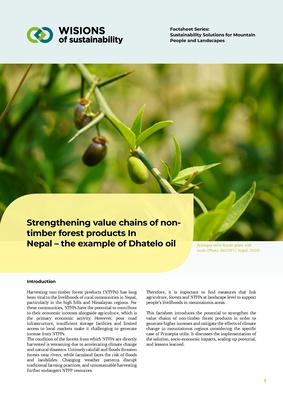
Strengthening value chains of non-timber forest products in Nepal – the example of Dhatelo oil
Highlighting sustainable economic growth, this factsheet focuses on strengthening value chains for non-timber forest products (NTFPs), specifically Dhatelo oil in Nepal. It outlines processing techniques, quality improvements, market access strategies, and enterprise support for wild-harvested resources. By linking local collectors with commercial processors and higher-value markets, the initiative generates sustainable, equitable income for rural households while incentivizing biodiversity conservation and forest stewardship.
Download in
Published in 2025