Overview
► Back to the overview "Mitigation and Intervention Techniques Related to Micro-hydro Power (MHP) Projects"
Gully Control
Stone Checkdams
| Objectives: A stone checkdam is a structure across the bottom of a gully or a small stream, which reduces the velocity of runoff and prevents the deepening and widening of the gully. Sediments accumulated behind a checkdam could be planted with crops or trees/shrubs grass and thus provide additional income to the farmer.
|
|
Brushwood Checkdams
| Objectives: Brushwood (BW) checkdams are vegetative measures constructed with vegetative materials, branches, poles/posts and twigs. Plant species which can easily grow vegetatively through shoot cuttings are ideal for this purpose. The objective of BWs is to retain sediments and slowdown runoff, and enhance the revegetation of gully areas. They are constructed either in single or double row. Some of the vegetation can be used for fodder. BWs are also ideal to stabilize conservation structures bunds, SS bunds, check dams, bench terraces, road sides, etc.
|
|
Gully Reshaping, Filling and Revegetation
- Objectives: Reshaping & Filling is an operation meant to decrease the gully erosion angle of incidence, create planting areas and encourage revegetation & stabilization, usually in small gullies or in other medium sized gullies from which most runoff has been diverted into a stable waterway or drainage line. When these gullies are shaped and smoothed, vegetation can be established over the leveled gullies. Some of these areas can be used for farming purposes. Revegetation of a gully is the plantation of the reshaped gully sides and bottom with multipurpose species so that it reduces runoff and control erosion and make the land productive. Gully revegetation implies reaching a dense vegetation cover over the entire gully surface, i.e. both sides and bottom by planting grasses, legumes and a variety of trees and shrubs.
|
 GullyReshapingRevegetation.png |
Sediment Storage (SS) and Overflow Earth Dams (SS Dams) for Productive Gully Control
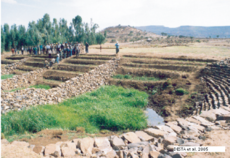
- Objectives: SS dams are water harvesting and conservation systems that convert unproductive large and active gullies into productive areas (fertile cultivated or fodder producing areas, mixed plantations, and fruit tree orchards). SS dams are stone-faced earth dams constructed across medium/large size gullies to trap sediments, collect water and divert excess runoff. SS dams accommodate the runoff generated by the catchment located above the gully. The structures are often constructed in series along the gully. It is just like creating a land that does not exist. Contribute significantly to protect cultivated lands, arrest gully expansion and recharge water tables. Huge potential in Ethiopia - can provide tens of thousand Km of gullies to poor households (small land holders and landless).
|
|
Sediment Storage (SS) and Overflow Soil Bunds (SS Bunds)
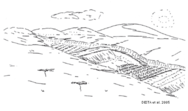
- Objectives: SS bunds are large and strongly built soil embankments, constructed across gullies, often in series. As for SS dams, their purpose is to create a new field for cultivation by allowing and helping the sedimentation (filling) of the space behind each bund. After rains, the new fields fill up and retain enough soil and moisture to grow crops. The excess runoff move to the next structure downstream through a spillway.
|
 SedimentStorageOverflowSoilBunds.png |
Further Information
References
- DESTA, L. et al. (2005): Part 1: Community Based Participatory Watershed Development: A Guideline. Addis Ababa: Ministry of Agriculture and Rural Development.