
Difference between revisions of "Decentralized Energy Generation and Waste Management in India"
From energypedia
***** (***** | *****) m |
***** (***** | *****) m |
||
| Line 16: | Line 16: | ||
{| border="0" cellspacing="3" cellpadding="5" style="width: 800px;" | {| border="0" cellspacing="3" cellpadding="5" style="width: 800px;" | ||
|- | |- | ||
| − | | The 60 kg/day Kitchen waste biogas plant at Postal Training Centre [PTC], Mysore, India implemented by NIE-CREST has solved the problems of waste disposal and created a value chain of waste to energy. The plant at present is partially fulfilling thermal energy demand, has achieved zero waste and low carbon footprint. Analysis of 60 days data shows generation of 251.65 m of biogas (100.66 kg LPG Eq.) from 2600 kg of waste amounting to INR. 9831.97 averaging to biogas generation of 0.097 m3/kg of waste and an average feed of 43.33 kg/day. The plant in a year saves | + | | The 60 kg/day Kitchen waste biogas plant at Postal Training Centre [PTC], Mysore, India implemented by NIE-CREST has solved the problems of waste disposal and created a value chain of waste to energy. The plant at present is partially fulfilling thermal energy demand, has achieved zero waste and low carbon footprint. Analysis of 60 days data shows generation of 251.65 m of biogas (100.66 kg LPG Eq.) from 2600 kg of waste amounting to INR. 9831.97 averaging to biogas generation of 0.097 m3/kg of waste and an average feed of 43.33 kg/day. The plant in a year saves 611.74 kg of LPG, reduces 1.85 tonnes of CO2 emission, converts15.82 tonnes of waste to energy & organic manure thus contributing to green economy. Further COD reduction of 74.7 %, BOD reduction of 80.9 % was achieved in outlet slurry. |
| − | 611.74 kg of LPG, reduces 1.85 tonnes of CO2 emission, converts15.82 tonnes of waste to energy & organic manure thus contributing to green economy. Further COD reduction of 74.7 %, BOD | ||
| − | reduction of 80.9 % was achieved in outlet slurry | ||
| [[File:Decentralized Energy Generation and Waste Management in India.pdf|250px|border|Decentralized Energy Generation and Waste Management in India.pdf]] | | [[File:Decentralized Energy Generation and Waste Management in India.pdf|250px|border|Decentralized Energy Generation and Waste Management in India.pdf]] | ||
|} | |} | ||
Latest revision as of 10:41, 10 June 2015

 |
 |
 |
 |
Decentralized Energy Generation and Waste Management in India
Presenter: Shamsundar Subbarao (University of Oldenburg ,Germany)
Presentation
| The 60 kg/day Kitchen waste biogas plant at Postal Training Centre [PTC], Mysore, India implemented by NIE-CREST has solved the problems of waste disposal and created a value chain of waste to energy. The plant at present is partially fulfilling thermal energy demand, has achieved zero waste and low carbon footprint. Analysis of 60 days data shows generation of 251.65 m of biogas (100.66 kg LPG Eq.) from 2600 kg of waste amounting to INR. 9831.97 averaging to biogas generation of 0.097 m3/kg of waste and an average feed of 43.33 kg/day. The plant in a year saves 611.74 kg of LPG, reduces 1.85 tonnes of CO2 emission, converts15.82 tonnes of waste to energy & organic manure thus contributing to green economy. Further COD reduction of 74.7 %, BOD reduction of 80.9 % was achieved in outlet slurry. | 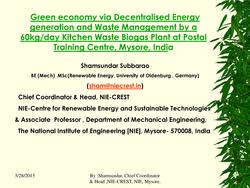
|
References
Shamsundar Subbarao: Micro Perspective for Decentralized Energy (MES) 2015, Bangalore, India.