
Difference between revisions of "AC Solar Photo-voltaic Micro-Grid in Indian Reserve Forest Areas- Experimenting the Implementation Challenge"
From energypedia
***** (***** | *****) m |
***** (***** | *****) m |
||
| (2 intermediate revisions by the same user not shown) | |||
| Line 16: | Line 16: | ||
{| border="0" cellspacing="3" cellpadding="5" style="width: 800px;" | {| border="0" cellspacing="3" cellpadding="5" style="width: 800px;" | ||
|- | |- | ||
| − | | Tribal communities based in reserve forest areas are denied from basic amenities such as electricity, transport and medication for safeguarding the endangered species and to avoid higher risks of forest | + | | Tribal communities based in reserve forest areas are denied from basic amenities such as electricity, transport and medication for safeguarding the endangered species and to avoid higher risks of forest fire.To benefit them with satisfactory power supply system, an efficient, safe, and environmental friendly technique must be employed. This paper addresses the approach for deploying an AC solar photo-voltaic micro grid and the role of engineering technology for its sustainability in Mendil, a village based in reserve forest area of Karnataka, India. We examine the location, plan for suitable electrification method and implement a 2kW micro-grid system for operational studies. The implemented system represents a model for practitioners involved in the behavioral analysis of solar photo-voltaic micro-grids in adverse geographical and climatic conditions |
| − | fire. To benefit them with satisfactory power supply system, an efficient, safe, and environmental friendly technique must be employed. This paper addresses the approach for deploying an AC solar photo-voltaic micro grid and the role of engineering technology for its sustainability in Mendil, a village based in reserve forest area of Karnataka, India. We examine the location, plan for suitable electrification method and implement a 2kW micro-grid system for operational studies. The implemented system represents a model for practitioners involved in the behavioral analysis of solar photo-voltaic micro-grids in adverse geographical and climatic conditions | ||
| [[File:AC Solar Photo-voltaic Micro-Grid in Indian Reserve Forest Areas- Experimenting the Implementation Challenge.pdf|250px|border|AC Solar Photo-voltaic Micro-Grid in Indian Reserve Forest Areas- Experimenting the Implementation Challenge.pdf]] | | [[File:AC Solar Photo-voltaic Micro-Grid in Indian Reserve Forest Areas- Experimenting the Implementation Challenge.pdf|250px|border|AC Solar Photo-voltaic Micro-Grid in Indian Reserve Forest Areas- Experimenting the Implementation Challenge.pdf]] | ||
|} | |} | ||
| Line 25: | Line 24: | ||
__NOEDITSECTION__ __NOTOC__ __NOTITLE__ | __NOEDITSECTION__ __NOTOC__ __NOTITLE__ | ||
| + | |||
| + | [[Category:Conference_Documentation]] | ||
Latest revision as of 11:55, 19 June 2015

 |
 |
 |
 |
AC Solar Photo-voltaic Micro-Grid in Indian Reserve Forest Areas- Experimenting the Implementation Challenge
Presenter: Kaustubh Rajendra karnataki, Tejas Kumar, Shodhan S, Mitavachan H, Ganesh Shankar and J Srinivasan
Presentation
| Tribal communities based in reserve forest areas are denied from basic amenities such as electricity, transport and medication for safeguarding the endangered species and to avoid higher risks of forest fire.To benefit them with satisfactory power supply system, an efficient, safe, and environmental friendly technique must be employed. This paper addresses the approach for deploying an AC solar photo-voltaic micro grid and the role of engineering technology for its sustainability in Mendil, a village based in reserve forest area of Karnataka, India. We examine the location, plan for suitable electrification method and implement a 2kW micro-grid system for operational studies. The implemented system represents a model for practitioners involved in the behavioral analysis of solar photo-voltaic micro-grids in adverse geographical and climatic conditions | 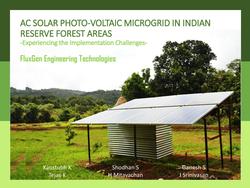
|
References
Kaustubh Rajendra karnataki, Tejas Kumar, Shodhan S, Mitavachan H, Ganesh Shankar and J Srinivasan: Micro Perspective for Decentralized Energy (MES) 2015, Bangalore, India.