Difference between revisions of "Western Balkan Power Sector"
***** (***** | *****) m Tag: 2017 source edit |
***** (***** | *****) m Tag: 2017 source edit |
||
| Line 13: | Line 13: | ||
This knowledge hub offers curated materials and information on the power sector in the Western Balkan countries. | This knowledge hub offers curated materials and information on the power sector in the Western Balkan countries. | ||
| − | - | + | The regional project "Green Agenda: Decarbonization of the Electricity Sector in the Western Balkans " is funded by the German Federal Ministry for Economic Cooperation and Development and implemented by the Deutsche Gesellschaft für Internationale Zusammenarbeit und Entwicklung (GIZ) GmbH over a period of 3 years between 11/2022 and 10/2025. |
| + | |||
| + | The project generally aims to strengthen power sector key actors’ confidence in the feasibility of an energy transition based on renewable energies. It is assumed that an increase of respective confidence translates into the project objective, i.e. "increased demand for technological, regulatory and personnel solutions for an ecologically sustainable and climate-friendly energy transition." As a regional project, the focus is on providing fundamental knowledge that is of equal importance for as many as possible of the Western Balkan (WB) countries. The transfer of this non-country specific knowledge on energy transition shall accelerate the demand for country-specific further elaboration, detailing and implementation of solutions. Corresponding in-depth support should subsequently be provided by other projects of the development partners’ community, especially within the framework of specific bilateral development measures. [[Western_Balkan_Power_Sector_-_About|Read more...]] | ||
<div class="grid stretch-items"> | <div class="grid stretch-items"> | ||
<div class="width-1-3" style="background-color: #8CCDCA"><span style="color:#FFFFFF;"><center>'''Project Pillar 1'''</center></span> | <div class="width-1-3" style="background-color: #8CCDCA"><span style="color:#FFFFFF;"><center>'''Project Pillar 1'''</center></span> | ||
Revision as of 14:42, 22 October 2024
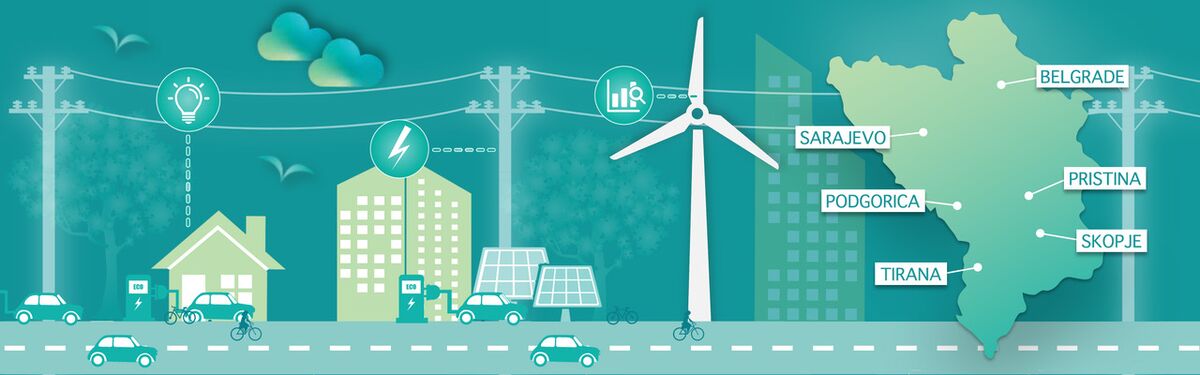
Welcome to the Western Balkan Power Sector Knowledge Hub!
This knowledge hub offers curated materials and information on the power sector in the Western Balkan countries.
The regional project "Green Agenda: Decarbonization of the Electricity Sector in the Western Balkans " is funded by the German Federal Ministry for Economic Cooperation and Development and implemented by the Deutsche Gesellschaft für Internationale Zusammenarbeit und Entwicklung (GIZ) GmbH over a period of 3 years between 11/2022 and 10/2025.
The project generally aims to strengthen power sector key actors’ confidence in the feasibility of an energy transition based on renewable energies. It is assumed that an increase of respective confidence translates into the project objective, i.e. "increased demand for technological, regulatory and personnel solutions for an ecologically sustainable and climate-friendly energy transition." As a regional project, the focus is on providing fundamental knowledge that is of equal importance for as many as possible of the Western Balkan (WB) countries. The transfer of this non-country specific knowledge on energy transition shall accelerate the demand for country-specific further elaboration, detailing and implementation of solutions. Corresponding in-depth support should subsequently be provided by other projects of the development partners’ community, especially within the framework of specific bilateral development measures. Read more...




Energy Landscape in the Western Balkans


Supported Projects
Project Resources
Funders / Partners